Passphrase vs Password: Which Is More Secure?
Compare passphrases and passwords by entropy, memorability, and attack resistance. Learn when to use a passphrase, how Diceware works, and NIST recommendations.
- password
- passphrase
- security
- diceware
- entropy
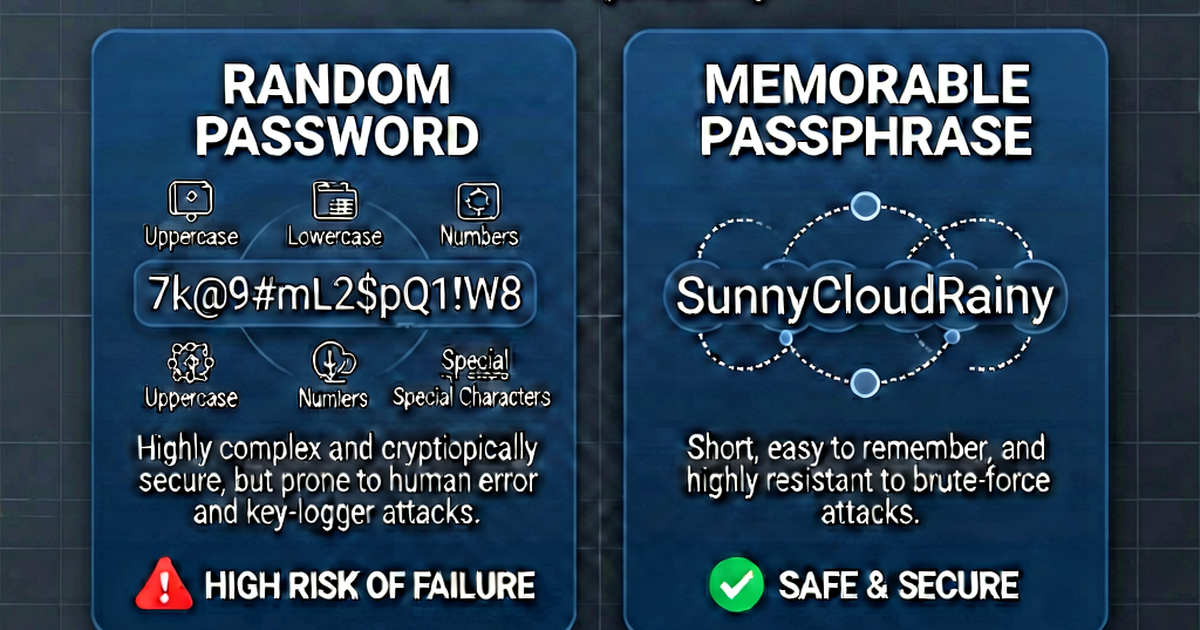
A password is typically a string of mixed characters. A passphrase is multiple words strung together. Both can be equally secure — but passphrases have advantages for cases where you need to memorize the secret.
What is a passphrase?
A passphrase is two or more random words:
correct horse battery staple
marble engine sunset radio
purple volcano coffee lamp
The key word is random. Phrases that come from your head — “ilovemy dog” or “letmein2026” — aren’t secure. Random word passphrases selected from a large wordlist are.
Entropy comparison
Security is measured in bits of entropy — how many guesses an attacker needs to brute-force the password.
Random character password (full ASCII charset, 95 options per character):
- 12 characters: ~79 bits
- 16 characters: ~105 bits
- 20 characters: ~131 bits
Random passphrase (Diceware, 7,776 words per roll):
- 4 words: ~51 bits
- 5 words: ~64 bits
- 6 words: ~77 bits
- 7 words: ~90 bits
- 8 words: ~103 bits
A 6-word Diceware passphrase (~77 bits) is roughly equivalent to a 12-character random character password in entropy. A 7-word passphrase (~90 bits) is very strong for most purposes.
When to use a passphrase
Use a passphrase when you need to memorize the secret:
- Password manager master password
- Full-disk encryption password (VeraCrypt, LUKS)
- PGP key passphrase
- SSH key passphrase
- Shared team secrets passed verbally
Use a random character password (via password manager) for everything else:
- Online account logins
- API keys
- Database passwords
The advantage of passphrases is memorability — four random words are much easier to remember than Xk9#mQ2!pLr7vN. The advantage of random character passwords is compactness — they pack more entropy per character.
How Diceware works
Diceware uses physical dice to ensure randomness:
- Roll 5 dice and record the numbers (e.g., 3-4-2-1-6)
- Look up the number in the Diceware wordlist (34216 = “mouse”)
- Repeat for each word
34216 = mouse
16326 = candy
52421 = pine
21341 = dry
46643 = rock
55624 = smart
Result: mouse candy pine dry rock smart
You can also use an offline Diceware tool or a password manager’s passphrase generator. The key is that the words are selected randomly, not by you.
Diceware wordlist size
The standard Diceware list has 7,776 words (6^5, since each word is chosen with 5 dice rolls). Each word contributes log₂(7776) ≈ 12.9 bits of entropy.
Some generators use larger word lists (EFF word lists have 7,776 words carefully chosen to be unambiguous when spoken). The entropy per word varies with list size.
The human-phrase trap
The biggest mistake is using a memorable sentence or phrase that comes from your head:
# These look like passphrases but are weak:
ilovemydog
correcthorsebatterystaple  ← famous xkcd example; now in attack wordlists
letmein1234
myfavoritecolor
Phrases from culture, movies, books, or your personal life are in attack wordlists. Only random selection from a large wordlist provides the security that passphrases promise.
NIST stance on passphrases
NIST SP 800-63B recommends allowing long passwords (passphrases) and not penalizing length. Verifiers should:
- Accept up to 64+ characters (enabling passphrases)
- Not restrict special characters or spaces
- Not force arbitrary complexity rules that make passphrases harder
Practical recommendation
| Use case | Recommendation |
|---|---|
| Password manager master password | 6-word Diceware passphrase |
| Full-disk encryption | 6-7 word Diceware passphrase |
| PGP/SSH key | 6-word Diceware passphrase |
| Website accounts | 20-char random password (via manager) |
| API keys | 32+ char random string (base62 or hex) |
| Shared team credentials | Password manager’s sharing feature |
For accounts where you have a password manager, use the longest random password the site allows. For secrets you must memorize, use a random passphrase.
Generate strong passwords and passphrases at passwordgen.io.
Related reading
-
What Makes a Good Password? Length, Entropy, and Randomness
Learn what actually makes a password good: length, randomness, uniqueness, and entropy. Debunks common myths and explains NIST 2024 password guidelines.
-
How to Create a Strong Password: A Practical Security Guide
Learn what makes a password strong in 2026: length, randomness, uniqueness, and manager use. Covers NIST guidelines, entropy, and what to avoid.
-
Password Generator: How to Generate Strong Passwords Online and in Code
Learn how to generate strong passwords online, in Python, JavaScript, and Bash. Covers cryptographically secure randomness, character sets, and length best practices.